go to all site settings and update the welcome page to contain default.aspx. view source will show that the site now has home tab as /sites/test/default.aspx.
Monday, October 18, 2010

Thursday, June 17, 2010
SharePoint local breadcrumb not showing
Problem: using the same master page, the local breadcrumb shows on some pages but not other sites/pages.
Upon digging, the no breadcrumb pages are in a folder instead of a doc library. Moving those pages to a doc lib and problem was solved.
Upon digging, the no breadcrumb pages are in a folder instead of a doc library. Moving those pages to a doc lib and problem was solved.
Thursday, April 1, 2010
Breadcrumb shows wrong url for a list
Came across this problem when i went in the list settings, the url on the breadcrumb shows the url of the web app instead of the url to the list itself.
Solution: it turns out on the list properties, it's missing the default view page. Go to SharePoint Designer, right click on the list to bring up the properties, under 'Supporting Files' tab, select the 'default view page'.
Solution: it turns out on the list properties, it's missing the default view page. Go to SharePoint Designer, right click on the list to bring up the properties, under 'Supporting Files' tab, select the 'default view page'.
Friday, February 12, 2010
Workflow showed 'stopped' for some users
I have a SPD workflow with a lookup to assigned to groups. The workflow will send send an email to the group and assign tasks to the gorup etc. For some users (all site col admins, WF runs w/o problems). For normal contributors, the workflow shows stopped after entering a record.
Solution: This is permission related. The user has to be able to see the group memberships. Go to 'site settings' -> 'People and Groups', go to each group and go to Group Settings to switch the 'Who can view the membership of the group?' to Everyone. The workflow will start the next time you enter a record.
Solution: This is permission related. The user has to be able to see the group memberships. Go to 'site settings' -> 'People and Groups', go to each group and go to Group Settings to switch the 'Who can view the membership of the group?' to Everyone. The workflow will start the next time you enter a record.
Monday, February 8, 2010
Filter between two dates using the DataView and jQuery
This is the second round of filtering between dates in a SharePoint DataView. With this version, you do not need to be using the filters from the Enterprise version. (I am using the Standard version for now so was forced to get this working....)
Step by Step Instructions:
1. Using SPD, create an asp.net page. Add in the web part to be filtered to the page.
2. Add 4 asp.net controls. I named them txtDate1, txtDate2 and alttxtDate1, alttxtDate2. Feel free to choose your own. Note: thanks to the views below, the txtDate1 and txtDate2 asp.net textboxes have to have the AutoPostBack attribute set to true. We will hide the latter two. (Now the reason for the latter two fields: After some digging, the filter takes the dates formatted as yy-mm-dd. We are in the US so we don’t want to display the date like this. Thus the use of alternate fields to pass in for processing, but display we’ll see the good display. >.< )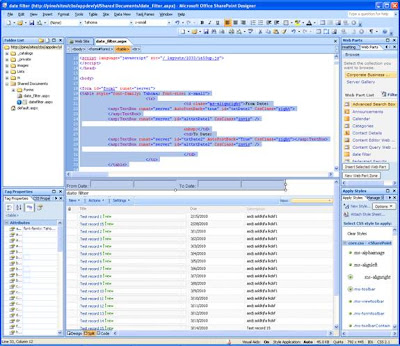
From Date:
<asp:TextBox runat="server" AutoPostBack="true" id="txtDate1" CssClass="right">
</asp:TextBox>
<asp:TextBox runat="server" id="alttxtDate1" CssClass="invis"/>
To Date:
<asp:TextBox runat="server" id="txtDate2" AutoPostBack="True" CssClass="right"></asp:TextBox>
<asp:TextBox runat="server" id="alttxtDate2" CssClass="invis"/>
3. Select the WebPart and convert it to XSLT dataview. We will filter using the two dates on the dataview.
4. Setup the dataview parameters:
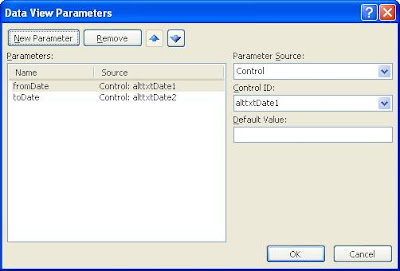
5. Setup the filter on the DataView using the parameters from step 4:
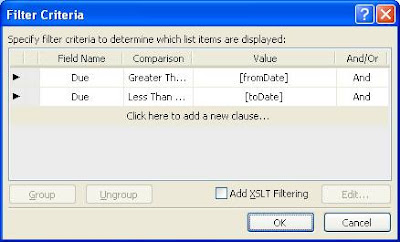
6. Add the jquery stuff to make it work:
<link rel="stylesheet" href="http://ajax.googleapis.com/ajax/libs/jqueryui/1.7.2/themes/ui-lightness/jquery-ui.css"
type="text/css" media="all" />
<script type="text/javascript">
if(typeof jQuery=='undefined'){
var jQPath="http://ajax.googleapis.com/ajax/libs/jquery/1.3.1/";
document.write('<script src="',jQPath,'jquery.min.js" type="text/javascript"><\/script>');
}
</script>
<script type="text/javascript" src="http://ajax.googleapis.com/ajax/libs/jqueryui/1.7.2/jquery-ui.min.js"></script>
<SCRIPT type=text/javascript>
$(function() {
$("#txtDate1").datepicker({altField: '#alttxtDate1', altFormat: 'yy-mm-dd'});
$("#txtDate2").datepicker({altField: '#alttxtDate2', altFormat: 'yy-mm-dd'});
});
</SCRIPT>
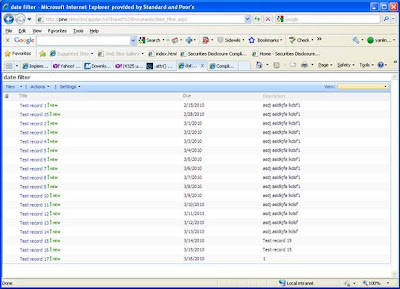
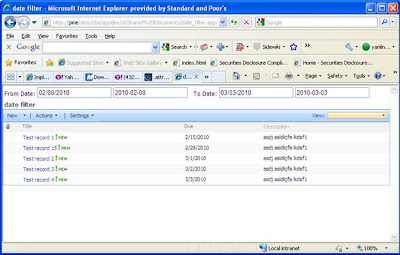
7. Result:
8. Of course, hide the latter two alt controls:
<style type="text/css">
.invis{
visibility:hidden;
width:30px;
}
</style>
and....Done!
Note: this could be extended to more filters. Just modify the DataView filters criteria....
Step by Step Instructions:
1. Using SPD, create an asp.net page. Add in the web part to be filtered to the page.

2. Add 4 asp.net controls. I named them txtDate1, txtDate2 and alttxtDate1, alttxtDate2. Feel free to choose your own. Note: thanks to the views below, the txtDate1 and txtDate2 asp.net textboxes have to have the AutoPostBack attribute set to true. We will hide the latter two. (Now the reason for the latter two fields: After some digging, the filter takes the dates formatted as yy-mm-dd. We are in the US so we don’t want to display the date like this. Thus the use of alternate fields to pass in for processing, but display we’ll see the good display. >.< )
From Date:
<asp:TextBox runat="server" AutoPostBack="true" id="txtDate1" CssClass="right">
</asp:TextBox>
<asp:TextBox runat="server" id="alttxtDate1" CssClass="invis"/>
To Date:
<asp:TextBox runat="server" id="txtDate2" AutoPostBack="True" CssClass="right"></asp:TextBox>
<asp:TextBox runat="server" id="alttxtDate2" CssClass="invis"/>
3. Select the WebPart and convert it to XSLT dataview. We will filter using the two dates on the dataview.
4. Setup the dataview parameters:
5. Setup the filter on the DataView using the parameters from step 4:

6. Add the jquery stuff to make it work:
<link rel="stylesheet" href="http://ajax.googleapis.com/ajax/libs/jqueryui/1.7.2/themes/ui-lightness/jquery-ui.css"
type="text/css" media="all" />
<script type="text/javascript">
if(typeof jQuery=='undefined'){
var jQPath="http://ajax.googleapis.com/ajax/libs/jquery/1.3.1/";
document.write('<script src="',jQPath,'jquery.min.js" type="text/javascript"><\/script>');
}
</script>
<script type="text/javascript" src="http://ajax.googleapis.com/ajax/libs/jqueryui/1.7.2/jquery-ui.min.js"></script>
<SCRIPT type=text/javascript>
$(function() {
$("#txtDate1").datepicker({altField: '#alttxtDate1', altFormat: 'yy-mm-dd'});
$("#txtDate2").datepicker({altField: '#alttxtDate2', altFormat: 'yy-mm-dd'});
});
</SCRIPT>
7. Result:

8. Of course, hide the latter two alt controls:
<style type="text/css">
.invis{
visibility:hidden;
width:30px;
}
</style>
and....Done!
Note: this could be extended to more filters. Just modify the DataView filters criteria....
Friday, August 14, 2009
infopath form quick note
Note: When a form has a dropdown from a reference list in SharePoint, changing the values of the reference list does NOT change the selected values in the existing forms....which is an excellent thing.
SSRS integration with MOSS notes
Some quick notes on integrating SSRS with MOSS. Using Sql 2005 SP2.
1. Configure Report Services BEFORE installing the add-in.
2. Must use the Reporting Services Configuration tool in Sql to configure the virtual directory. DO NOT use IIS.
3. If don't see the Reporting Services section in CA after installing the add-in, check and see if the Reporting Services site collection feature is enabled in the CA. Must login as a site collection admin for the CA to see this section.
1. Configure Report Services BEFORE installing the add-in.
2. Must use the Reporting Services Configuration tool in Sql to configure the virtual directory. DO NOT use IIS.
3. If don't see the Reporting Services section in CA after installing the add-in, check and see if the Reporting Services site collection feature is enabled in the CA. Must login as a site collection admin for the CA to see this section.
Thursday, April 30, 2009
Cannot delete content type from list
Problem: Added in a content type to a list and it's not letting me delete it. Says content type in use.
Soln: Modify the view of the list and see which item is using the content type. (Check the 'content type' column to have it in the view.) Then change the content type to some other one (perhaps 'Document'). After all the items are changed to a different content type, you can then delete the one that says in use.
Soln: Modify the view of the list and see which item is using the content type. (Check the 'content type' column to have it in the view.) Then change the content type to some other one (perhaps 'Document'). After all the items are changed to a different content type, you can then delete the one that says in use.
Friday, April 3, 2009
Alerts setup findings
For users to see their own alerts on "My Settings", they must have at least READ access.
With READ access, they see the "alert me", but when they click on "alert me", it gives "access denied".
With anonymous access turned on, everyone can read. However, if user is not in read access category, user will NOT get the alert.
With READ access, they see the "alert me", but when they click on "alert me", it gives "access denied".
With anonymous access turned on, everyone can read. However, if user is not in read access category, user will NOT get the alert.
Tuesday, March 24, 2009
Generate Unique ID for InfoPath form
We are going to generate a Unique ID for each InfoPath form using a SharePoint list. We will then use this ID as the unique filename.
1. Create a SharePoint list with a key column:

2. Each time we load the InfoPath form, we will grab the key and then increment the key by 1:
XPathNavigator xNav = MainDataSource.CreateNavigator();
XPathNavigator nodeTermid = xNav.SelectSingleNode("my:myFields/my:TermID",
NamespaceManager);
if (nodeTermid.InnerXml == "0")
{
string termid = getTermID();
nodeTermid.SetValue(termid);
….
}
private string getTermID()
{
string termSite = ConfigurationManager.AppSettings["url_termsite"].ToString();
string termIDListName = ConfigurationManager.AppSettings["list_termid"].ToString();
string termIDKey = string.Empty;
SPSite mysite = null;
SPWeb site = null;
try
{
mysite = new SPSite(termSite);
site = mysite.RootWeb;
site.AllowUnsafeUpdates = true;
SPList list = site.Lists[termIDListName];
SPQuery query = new SPQuery();
string queryText = "<Where><Eq><FieldRef Name='{0}'" +
"/><Value Type='Text'>{1}</Value></Eq></Where>";
queryText = string.Format(queryText, "Title", "termid");
query.Query = queryText;
SPListItemCollection results = list.GetItems(query);
foreach (SPListItem item in results)
{
termIDKey = item["key"].ToString();
}
int newID = Convert.ToInt32(termIDKey) + 1;
UpdateFieldValues(termIDListName, "key", newID.ToString(), "Title", "termid");
return termIDKey;
}
catch (Exception ex)
{
throw ex;
}
finally
{
if (mysite != null) mysite.Dispose();
if (site != null) site.Dispose();
}
}
public static void UpdateFieldValues(string listName, string attribute, string attrValue,
string filterField, string filterValue)
{
SPSite mysite = null;
SPWeb site = null;
try
{
mysite = new SPSite(ConfigurationManager.AppSettings["url_termsite"].ToString());
site = mysite.RootWeb;
site.AllowUnsafeUpdates = true;
SPList list = site.Lists[listName];
SPQuery query = new SPQuery();
string queryText = "<Where><Eq><FieldRef Name='{0}'" +
"/><Value Type='Text'>{1}</Value></Eq></Where>";
queryText = string.Format(queryText, filterField, filterValue);
query.Query = queryText;
SPListItemCollection results = list.GetItems(query);
foreach (SPListItem item in results)
{
item[attribute] = attrValue;
item.UpdateOverwriteVersion();
}
}
catch (Exception ex)
{
throw ex;
}
finally
{
if (mysite != null) mysite.Dispose();
if (site != null) site.Dispose();
}
}
1. Create a SharePoint list with a key column:

2. Each time we load the InfoPath form, we will grab the key and then increment the key by 1:
XPathNavigator xNav = MainDataSource.CreateNavigator();
XPathNavigator nodeTermid = xNav.SelectSingleNode("my:myFields/my:TermID",
NamespaceManager);
if (nodeTermid.InnerXml == "0")
{
string termid = getTermID();
nodeTermid.SetValue(termid);
….
}
private string getTermID()
{
string termSite = ConfigurationManager.AppSettings["url_termsite"].ToString();
string termIDListName = ConfigurationManager.AppSettings["list_termid"].ToString();
string termIDKey = string.Empty;
SPSite mysite = null;
SPWeb site = null;
try
{
mysite = new SPSite(termSite);
site = mysite.RootWeb;
site.AllowUnsafeUpdates = true;
SPList list = site.Lists[termIDListName];
SPQuery query = new SPQuery();
string queryText = "<Where><Eq><FieldRef Name='{0}'" +
"/><Value Type='Text'>{1}</Value></Eq></Where>";
queryText = string.Format(queryText, "Title", "termid");
query.Query = queryText;
SPListItemCollection results = list.GetItems(query);
foreach (SPListItem item in results)
{
termIDKey = item["key"].ToString();
}
int newID = Convert.ToInt32(termIDKey) + 1;
UpdateFieldValues(termIDListName, "key", newID.ToString(), "Title", "termid");
return termIDKey;
}
catch (Exception ex)
{
throw ex;
}
finally
{
if (mysite != null) mysite.Dispose();
if (site != null) site.Dispose();
}
}
public static void UpdateFieldValues(string listName, string attribute, string attrValue,
string filterField, string filterValue)
{
SPSite mysite = null;
SPWeb site = null;
try
{
mysite = new SPSite(ConfigurationManager.AppSettings["url_termsite"].ToString());
site = mysite.RootWeb;
site.AllowUnsafeUpdates = true;
SPList list = site.Lists[listName];
SPQuery query = new SPQuery();
string queryText = "<Where><Eq><FieldRef Name='{0}'" +
"/><Value Type='Text'>{1}</Value></Eq></Where>";
queryText = string.Format(queryText, filterField, filterValue);
query.Query = queryText;
SPListItemCollection results = list.GetItems(query);
foreach (SPListItem item in results)
{
item[attribute] = attrValue;
item.UpdateOverwriteVersion();
}
}
catch (Exception ex)
{
throw ex;
}
finally
{
if (mysite != null) mysite.Dispose();
if (site != null) site.Dispose();
}
}
Subscribe to:
Posts (Atom)